Jump to6 sections
One switch lets Google pick your search terms, headlines and landing pages. Here is how it works and how to roll it out with control.
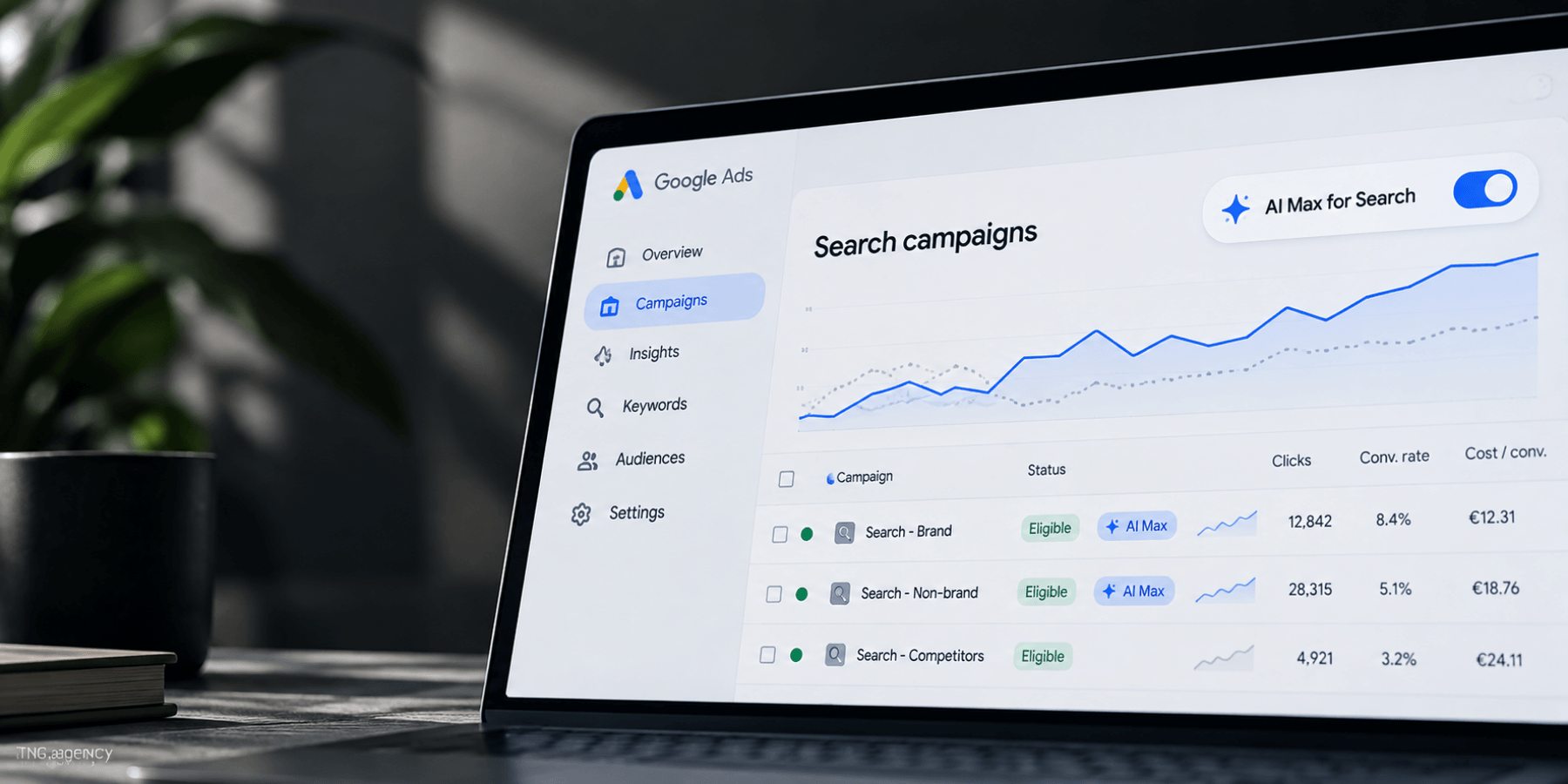
In May 2025, Google added one new switch to the settings of search campaigns: AI Max for Search. One click, and your campaign decides for itself which search terms it shows up for, which headlines it uses and which page it sends people to. It sounds like a small setting, but it touches exactly the three things a search campaign has always been built on: keywords, ad copy and landing pages.
Plenty of advertisers have seen the button by now, few know what it actually does. In this article we explain how AI Max works, when it pays off and how to test it without handing your budget away.
What is AI Max for Search?
AI Max for Search is a bundle of AI features you switch on inside an existing search campaign. You don't build a new campaign and you don't throw away your structure. Your keywords, ad groups and bid strategy stay in place. AI Max adds a layer on top that searches wider and fills in more by itself.
The difference with Performance Max matters. Performance Max spreads your budget across every Google channel, from YouTube to Gmail. AI Max stays within the search network. If you run search campaigns and want to keep the control that comes with search, this is the more interesting development.
The three parts of AI Max: search terms, text and URLs
Search term matching. AI Max combines broad match with keywordless technology. Google looks at your existing keywords, your ads and the content of your website, and finds relevant searches to go with them. Including searches you would never have come up with yourself.
Text customisation. Based on your landing page and existing ads, Google writes extra headlines and descriptions, tailored to the search. Someone asking a specific question gets an ad that sits closer to that question than your fixed set of headlines.
Final URL expansion. Google may send the searcher to a different page on your site than the URL in your ad, if that page is a better match. For a web shop with thousands of product pages, that can deliver a lot. For a site with one wrong page that happens to perform well, it can also cost a lot.
You can switch these parts on or off separately. That is the first thing most advertisers overlook.
Why AI Max is mostly a data question
AI Max learns from one thing: which clicks lead to a conversion. So whatever you measure as a conversion is what the system will go looking for. If every visit to your contact page counts as a lead, AI Max will neatly find you more visitors to your contact page. Not customers.
That makes measurement more important than the switch itself. Before you turn on AI Max, you want to know your conversions are right, that they aren't counted twice and that their value is close to what they really bring in. In many accounts we take over, that isn't the case. Solid marketing analytics isn't a side issue here, it's the precondition.
A second point: AI Max needs volume to learn. A campaign with a handful of conversions a month gives the system too little signal. It then searches widely without knowing what works, and you pay for the lessons.
The AI Max for Search controls to set from day one
AI Max isn't an all-or-nothing button. Google added a set of controls, and they make the difference between scaling with control and spending blind.
- Brand exclusions and inclusions. Exclude brand names you don't want to show up for, or limit a campaign to your own brand.
- URL exclusions. Switch off pages that should never serve as a landing page: vacancies, blog, terms and conditions, sold-out categories.
- Location of interest. Target what location people are searching for, not just where they are.
- Negative keywords. They still work as before, and you need them more than ever.
Set up URL exclusions before you turn on URL expansion, not after. A campaign that sends traffic to your vacancies page in its first week learns from that too.
How to test AI Max without wrecking your account
The temptation is to switch on AI Max everywhere at once. Don't. Pick one search campaign with enough conversions and stable performance, and enable AI Max there. Google offers an experiments feature that lets you run the same campaign with and without AI Max side by side. Use it, so you compare like with like.
During the test, don't just look at cost per conversion. Open the search terms report, where AI Max shows up as a separate source of searches. There you see which new search terms the system found, which headlines it wrote and which pages it sent people to. That report tells you more about quality than the total figure does.
Give the test a few weeks. The first days are the learning phase, and the numbers jump all over the place. Draw conclusions after five days and you're measuring noise. This is exactly where outsourcing Google Ads to someone who lives in search terms reports every day makes the difference: the signal is in the details, not in the dashboard.
A few situations where you're better off leaving AI Max alone for now:
- Your conversion tracking is unreliable or counts micro-actions.
- Your campaign gets only a few conversions a month.
- You work in a sector with strict rules on what ads may promise. You'll want to review text written by Google first.
What AI Max says about the future of search ads
AI Max fits a broader shift. People type longer questions, talk to their phones and ask follow-up questions. A list of exact keywords matches that less and less. Google responds with systems that read the intent behind the question instead of the literal words.
That shift isn't only happening at Google. Ad space is emerging inside AI assistants too. Anyone already gaining experience with advertising in ChatGPT sees the same pattern: less steering on keywords, more on context, data and a landing page that genuinely answers the question.
The advertiser's role changes with it, but it doesn't disappear. You decide less about which search term you appear for. You do decide what the system learns, which pages take part, which brands stay out and whether the numbers are right. That is less button-pushing and more direction.
So AI Max for Search doesn't replace a good search campaign. It amplifies it. If the basics are right, with clean conversion data, strong landing pages and clear exclusions, AI Max finds searchers you would otherwise have missed. If the basics are off, it mostly amplifies that.