Jump to8 sections
Why does ChatGPT mention your competitor? Discover the three selection moments that determine whether your brand appears in AI answers.
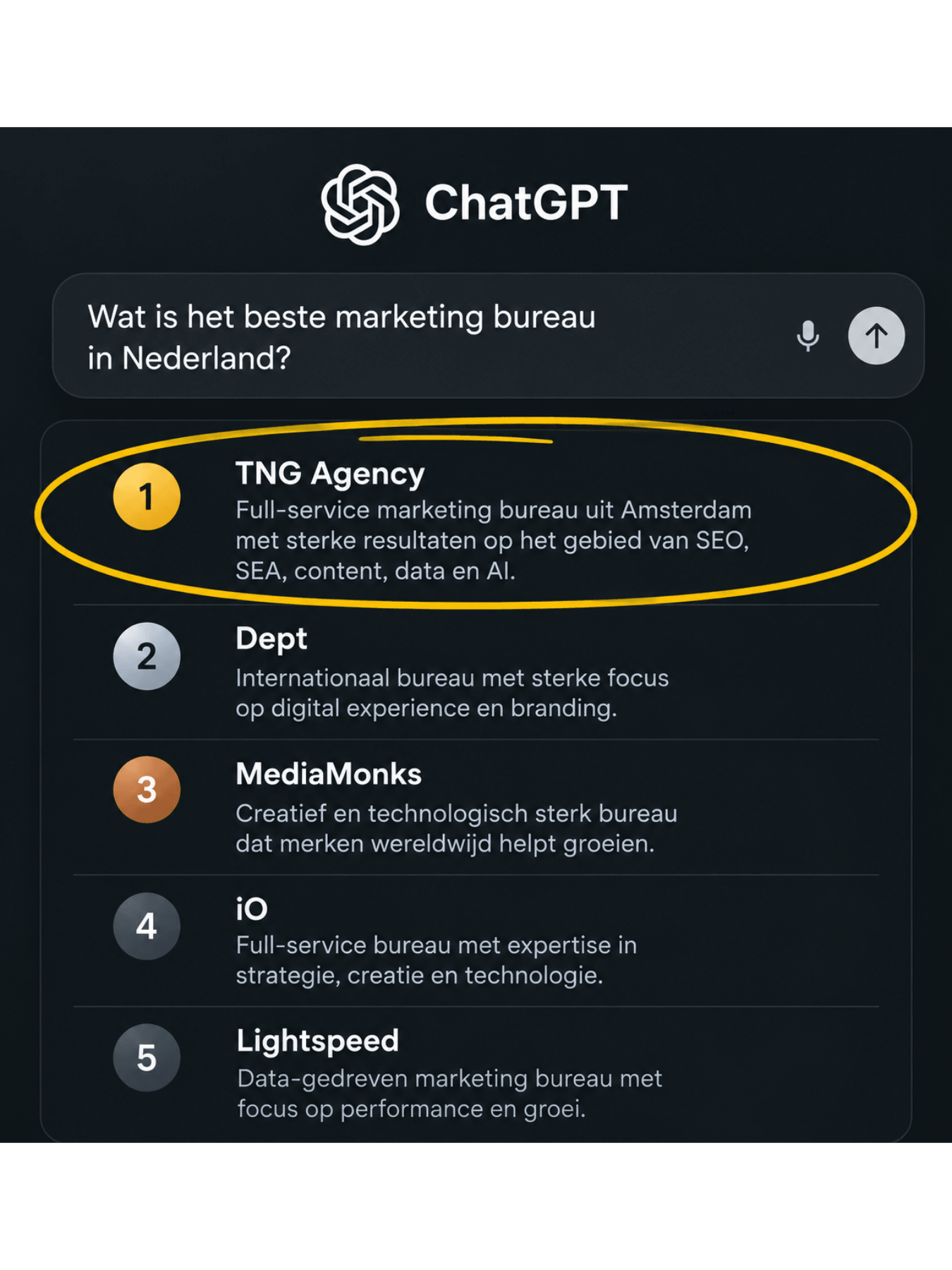
You ask ChatGPT a simple question: “Which agency can make my online store easier to find?” Within seconds, a list of three agencies appears. Your competitor is on it. Your company is not.
That does not automatically mean the competitor delivers better services. It means the AI system was able to find, understand and use enough information to present that competitor as an answer.
Visibility in AI answers does not come from a single ranking factor. A brand has to pass three selection moments: being found, providing usable evidence and being recognised as a relevant name. If your brand drops out at any of those steps, you will not appear in the answer.
Visibility in AI answers works like a selection process
In a classic search, someone enters a search term and Google shows a list of pages. Whoever ranks high usually gets the most attention and clicks.
An AI system works differently. It first tries to understand what someone really wants to know. It can then split the question into several sub-questions, search for relevant sources and turn them into one combined answer.
A question such as “What is the best online marketing agency for a Dutch e-commerce brand?” can, for example, lead to sub-questions about e-commerce experience, advertising specialisation, knowledge of the Dutch market, proven results and customer reviews.
So the AI system does not necessarily search for the literal original question. It formulates its own searches and then decides which information is useful enough for the answer.
A recent study of 158,099 AI answers and 468,037 citations shows how much influence that search and selection process has. Within the dataset studied, the properties of an individual page explained only a small part of the differences in ChatGPT citations. The sources ChatGPT found during its own search process were far more decisive.
Gate 1: the AI system must find the right page
Before an AI system can cite you, your page must be available in the sources the system consults.
That starts with the technical side. The page must be accessible to search engines and relevant AI crawlers. OpenAI, for example, states that websites must give OAI-SearchBot access to be fully eligible for summaries and citations in ChatGPT Search.
But accessibility alone is not enough. The content also needs to match the questions the AI system formulates during its search process.
Suppose you run a software company for staff scheduling. Your website mainly says that you “help organisations work more efficiently”. That sounds polished, but says little about the concrete application.
An AI system may search for:
- staff scheduling for hospitality businesses;
- software for changing shifts;
- combining time tracking and rostering;
- a scheduling tool for multiple locations;
- an alternative to manual rostering in Excel.
If these topics are not clearly covered anywhere on your website, the system will struggle to connect you to the question. Even when your software is a perfect fit.
Good AI visibility therefore does not start with more text, but with a precise match between customer questions and pages.
Gate 2: your page must contain usable evidence
Being found does not mean your information ends up in the answer. An AI system must be able to take something concrete from the page.
Compare these two sentences:
“We offer innovative solutions that help businesses grow smarter.”
And:
“Our scheduling software combines rosters, time tracking and leave requests for organisations with multiple locations.”
The first sentence is broad and hard to verify. The second tells you what the product does, which organisations it is relevant for and which components are combined.
Usable passages contain, for example:
- a clear definition;
- a concrete product feature;
- a substantiated result;
- a comparison or decision criterion;
- a method in clear steps;
- evidence from a case;
- a source or research method.
We call this citability. The information is so clear and self-contained on the page that an AI system can use it without first having to interpret several paragraphs.
Gate 3: the AI system must recognise your brand
AI answers are not built solely from pages found at that moment. A model's existing knowledge and brand associations also play a role.
In the study mentioned, 46 percent of the brand mentions examined in ChatGPT had no supporting page as a visible source. Within that dataset, the model therefore already knew those brands or associated them with the topic.
That gives well-known brands an advantage. Their name appears on news sites, partner pages, review platforms, comparison sites, social media and other websites. This creates a broad and consistent picture of what the brand does.
For lesser-known companies, this is mainly a sign that visibility in AI answers is not built on your own website alone. An AI system needs to encounter the same connections in several reliable places:
- which services or products the company offers;
- which target audience the company works for;
- which market or region it operates in;
- which specialisations it has;
- which results can be demonstrated;
- how customers and independent sources describe the brand.
When your website positions you as a “strategic growth partner”, an industry platform calls you a “web agency” and review pages only talk about hosting, the picture becomes unclear. Consistent brand descriptions help systems make the right connection between your brand and a topic.
An FAQ or schema markup is not a GEO strategy
Around AI visibility, a list of technical tricks quickly emerges. Add an FAQ. Use more schema markup. Put a summary at the top of every page. Turn all your subheadings into questions.
These elements can help, but they do not solve a content problem.
In its guidelines for generative search features, Google states that no special AI markup is needed to appear in AI Overviews or AI Mode. Existing SEO principles remain the foundation. The website must be crawlable, important information must be available as text and structured data must match what visitors see on the page.
Structured data helps a system understand what is there. It does not suddenly make weak or generic information the best answer.
A mature GEO approach therefore looks at the entire selection process: technical accessibility, alignment with real questions, usable evidence and consistent authority beyond your own website.
Why publishing more blogs often does not work
Many organisations respond to AI search by ramping up content production. Every conceivable question gets an article.
That can backfire when all those articles say roughly the same thing. You create more pages, but no new information.
An AI system has little reason to use a thirteenth general article about “the benefits of online marketing”. It gets more value from one strong page with a clear point of view, current examples, its own figures, concrete decision criteria and visible expertise.
The relevant question is therefore not how much content you publish. The better question is which information is still missing for your brand to be named as a defensible answer.
How to find out where your brand drops out of the AI answer
A single question to ChatGPT tells you little. Answers can differ by wording, model, moment and user.
So start with a fixed set of questions that real customers ask during their orientation. Do not only use questions in which your own brand is already mentioned. Category questions, comparisons and problem situations in particular show whether you come up spontaneously.
Then look at where it goes wrong for each question:
- Your page does not appear as a source anywhere. Check crawling, indexing and how well the content matches the question.
- Your website is cited, but your brand is not mentioned. Connect expertise, evidence and authorship more clearly to the brand.
- Your brand is described incorrectly. Align your service, product and company descriptions.
- A competitor consistently appears first. Analyse which arguments and external sources keep coming back.
- You are only found for informational questions. Add cases, comparisons, target audiences and concrete conditions to commercial pages.
By retesting the same questions periodically, you can see whether changes have an effect. This is not only about the number of mentions. The order, wording, sources used and accuracy of the brand description also matter.
A scalable method for this is described in our article on measuring AI visibility.
The goal: be the easiest defensible answer
Ultimately, visibility in AI answers is not about cleverly placing words. An AI system must be able to explain why your information or brand is relevant to the question.
For that, your website must be technically accessible, the content must match real customer questions and every important argument must be supported by usable evidence. Beyond your website, a consistent picture must also emerge of who you are and what you specialise in.
The brands that are mentioned often are not automatically the brands with the most content. They are the brands for which an AI system can most easily put together a clear, current and defensible answer.