Jump to11 sections
After France, supermarket refrigeration in Belgium, Luxembourg and Sweden has also been hacked. What happens to search behaviour, customer trust and conversion when a digital incident hits the service a brand delivers?
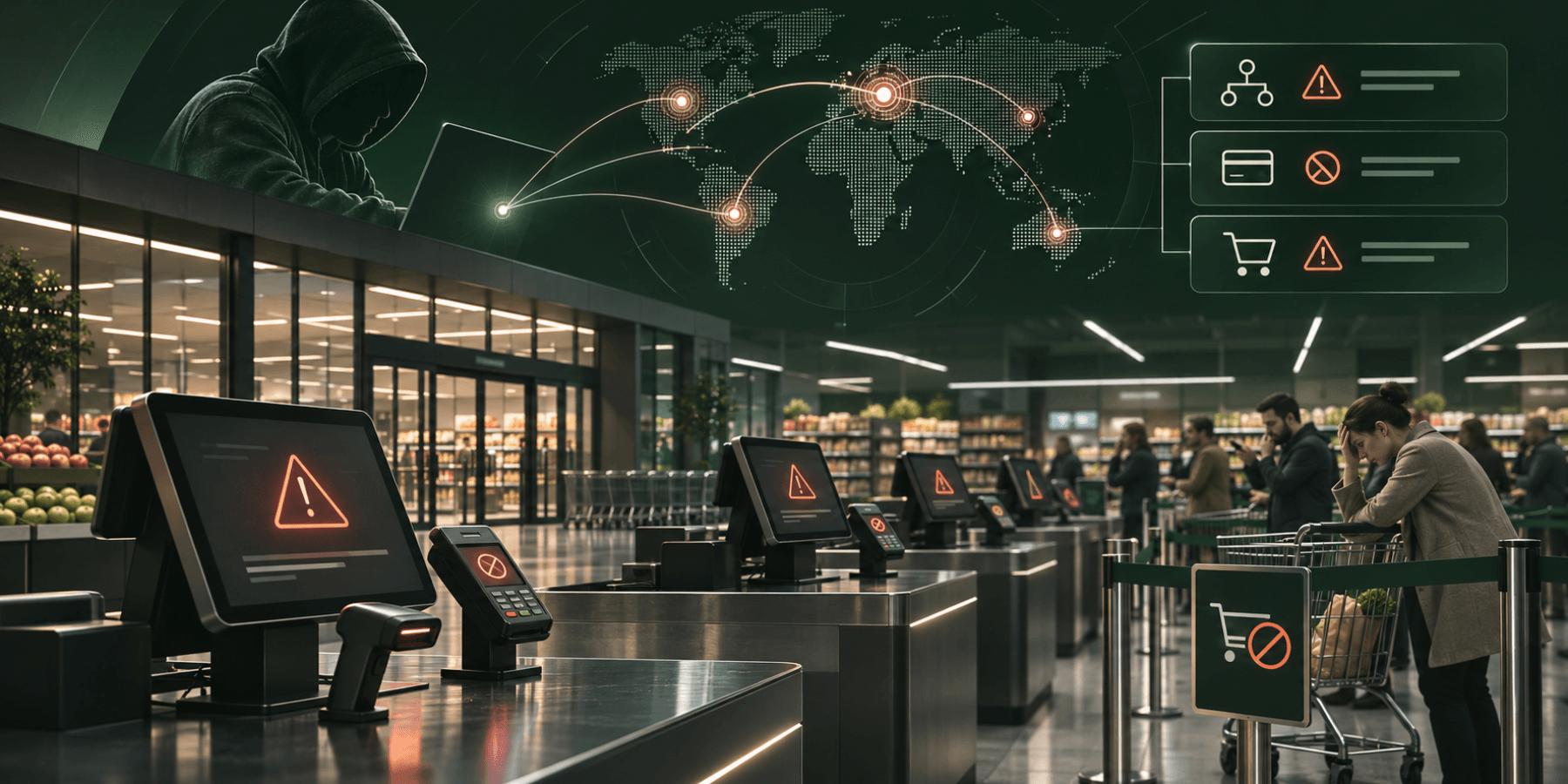
On 2 November 2026, refrigerators and freezers in supermarkets in Belgium, Luxembourg and Sweden were hacked. In dozens of Delhaize stores, fifteen Belgian Carrefour branches and several Swedish supermarkets, temperatures suddenly rose. Some stores brought in refrigerated trucks to save their stock.
The attack came three weeks after a similar incident in France. There, the refrigeration systems of hundreds of stores were disrupted and some units were set to 50 degrees, forcing stores to throw away food. An attack like this starts with technology, but it also costs digital brand trust.
According to coverage of the new attack on supermarket refrigeration, Delhaize store managers received a text message about the temperature rise at around 4 a.m. Carrefour and the Swedish chains ICA and Coop were also affected.
A cyberattack is therefore no longer limited to a server, website or database. As soon as digital systems control physical services, a single incident becomes immediately visible in stores, products and the customer experience.
From technical incident to marketing problem
Securing refrigeration systems is a job for cybersecurity specialists. The consequences for the customer, however, fall within the domain of marketing.
A customer sees empty fridges, cannot buy certain products and reads reports about food that may no longer be safe. That customer then goes online looking for answers.
From that moment on, the incident affects:
- Search behaviour around the brand
- News results in Google
- Trust in the service
- Website and app usage
- Customer questions and reviews
- Conversion and customer retention
- The reputation of the brand
A digital incident becomes a marketing problem as soon as customers change their behaviour.
That is where it touches our work. TNG does not prevent the technical attack. We do help brands understand what such an event does to their online visibility, website behaviour and commercial performance.
Search behaviour changes immediately after a cyberattack
Normally, people search for a brand to view a product, place an order or find a location. After a cyberattack, that intent shifts.
Searches can turn into:
- Delhaize hack
- Delhaize refrigeration
- Delhaize food safe
- Carrefour cyberattack
- Supermarket refrigeration hacked
- Ahold Delhaize outage
- Delhaize customer service
- Is my order safe?
- Has my data been leaked?
Total search volume for a brand can rise as a result, while the commercial value of that traffic actually falls.
A spike in branded search is therefore not automatically positive. The difference lies in the question behind the search. Someone looking for a deal has a different intent than someone who wants to know whether products are still safe.
With keyword research, Google Trends, Search Console and an analysis of the search results, you can make that shift visible. It is part of a broader SEO and GEO approach.
Who controls the answer in Google?
After an incident, news articles, public customer reactions and social media posts appear around the brand name. If the brand itself publishes little, external sources decide which information customers see first.
An official information page can partly absorb this, provided it is easy to find, up to date and useful. The page answers concrete questions:
- What happened?
- Which products or services are affected?
- Is there a safety risk?
- Which locations are experiencing problems?
- What is the organisation doing?
- Does the customer need to take action?
- When will the next update follow?
By publishing updates on one fixed URL, the brand builds a central source. News media, search engines and AI systems can then all refer to the same information. How such a source ends up in a ChatGPT answer is covered in our article on visibility in AI answers.
Scattered posts on social media channels are less suitable for this. They quickly become outdated and not every customer finds them.
The website becomes part of crisis communication
During an incident, a website is more than a sales channel. It is the place where customers look for confirmation. At that moment, a visitor does not want to read general brand promises, but to find out quickly what is going on.
A good incident page therefore contains:
- A clear date and time of the latest update
- A short summary at the top
- Concrete consequences for customers
- Answers to the most important questions
- Instructions if customers need to do something
- An overview of restored services
- A warning about possible phishing
- Contact options that actually work
The page must also be able to handle a sudden traffic spike. When news of an incident spreads, thousands of people may search for the same information at the same time.
A fast, logically structured website then removes uncertainty. We apply the same principle to websites that combine findability, conversion and tracking.
Without proper tracking, the commercial impact remains unknown
The direct damage of an attack on refrigeration systems is visible. Products are lost, engineers need to come out and temporary refrigerated trucks arrive. The consequences for marketing are harder to calculate.
How many customers visited the website after the news? What information were they looking for? Did more visitors drop off? Did customer questions increase? Did people search for a competitor more often?
To investigate this, your web and app tracking needs to be in order before the incident. Relevant signals include:
- Changes in branded search traffic
- Increased traffic to customer service pages
- Searches within your own website
- A decline in orders or enquiries
- Changes in conversion per channel
- An increase in abandoned shopping carts
- Use of alternative contact options
- Recovery of traffic and conversion in the weeks that follow
A standalone GA4 dashboard does not automatically tell you what is happening. You need to know in advance which events, pages and customer actions matter.
Within our data and tracking services, we connect website behaviour, campaigns and conversions. That shows where in the customer journey trust drops away and where recovery begins.
Technical recovery is not the same as commercial recovery
A refrigeration system can be reset or disconnected from the internet, as Delhaize says it did immediately. That may resolve the technical disruption. For the customer, however, the incident is not necessarily over.
News articles remain findable. Searches around the incident can continue and customers may become more hesitant to place a new order. Reviews and comments also stay online after the recovery.
A brand therefore goes through two recovery processes:
- Technical and operational recovery
- Recovery of the digital customer journey
The first process is about systems, stores and products. The second is about information, trust and customer behaviour.
A brand that only communicates until the outage is resolved may stop too early. Afterwards, customers still want to know what has been checked, which measures have been taken and why the same situation will not happen again.
The earlier attack on Ahold Delhaize raises the reputation question
The attack on the refrigeration systems came shortly after another incident at Ahold Delhaize.
In October, following a cyberattack, the group took several systems offline as a precaution. In the Netherlands, this temporarily took down the Albert Heijn website and app, among other things, customer service could not be reached and online orders were not delivered. Etos and Gall & Gall also experienced outages.
According to Delhaize, whether there is a link between that attack and the refrigeration problems is still being investigated. No link has been confirmed.
For consumers, that nuance can disappear. Within a short period, they once again see the same company and brand names in combination with a cyber incident.
Repetition shapes perception. One outage can be seen as an exception. Multiple incidents can raise questions about an organisation's structural control.
That makes clear communication even more important. The brand must not only explain what happened, but also what is and is not connected to earlier incidents.
AI can accelerate both attack and defence
The coverage has not established that AI was used in the attacks on the supermarket refrigeration. The scale of the incidents does show why AI could accelerate future attacks.
An attacking AI system can scan large numbers of connected devices. It can look for outdated software, publicly accessible management environments and recurring configuration errors.
At the same time, defensive AI can recognise unusual temperature changes, suspicious logins and abnormal defrost cycles. The system can then raise an alert or temporarily isolate equipment.
The danger is that both sides react ever faster. A defence that is too cautious may let an attack through. A defence that is too aggressive can block legitimate users or take entire systems offline unnecessarily.
The technical question then becomes who reacts faster. For the brand, a different question remains more important: can the organisation explain to customers what is happening and what the consequences are?
Digital brand trust is visible in behaviour
Brand trust is often researched with questionnaires. With a digital incident, you can also look at actual behaviour. Think of:
- Which questions people ask Google
- Which pages they visit
- Where they drop off
- How often they get in touch
- Which alternatives they search for
- Whether conversion recovers after the incident
- How long negative search results remain visible
This data does not tell you exactly what every customer thinks. It does show where uncertainty arises and which commercial consequences come with it.
For brands, that is more useful than a general reputation score alone. It makes clear which information is missing and at what moment the customer journey stalls.
AI answers are part of this too. By measuring AI visibility, you can see what ChatGPT and Gemini say about your brand and whether an incident lingers in those answers.
Where TNG helps brands
TNG is not a cybersecurity agency. Our role begins the moment a technical incident starts to affect reach, behaviour and conversion.
We help organisations with, among other things:
- Researching how search behaviour around the brand changes
- Making visible which questions customers ask
- Developing findable information and landing pages
- Setting up reliable website and app tracking
- Analysing drop-off in the digital customer journey
- Monitoring organic traffic and conversion recovery in a Looker Studio dashboard
- Structuring content for Google and AI systems with GEO optimisation
- Improving websites based on actual behaviour with conversion optimisation
Want to know whether your website, content and tracking provide enough insight when customer behaviour suddenly changes? You can have that assessed through an introductory meeting with TNG Agency.
Cybersecurity ultimately affects the entire customer journey
The attacks on supermarket refrigeration show how closely technology, service and brand experience are connected.
A hacker does not need to steal customer data directly to damage trust. It is enough for products to disappear, services to fail and customers to no longer know what they can trust.
Technical security determines how much damage an attack can cause. The website, data and communication determine how much uncertainty remains among customers afterwards.
That is where digital marketing comes in: making the digital customer relationship measurable and recoverable.